About: this is meant to be a collection of links and external resources relating to TPA stuff, but also a sort of memo about what self-funded insurance is and how it works. Most people have no idea how self-funded insurance works.
United Healthcare makes >$5B PROFIT per quarter. They can make this money because most of their customers don't understand self-funding.
Ground floor: What is self-funded insurance?
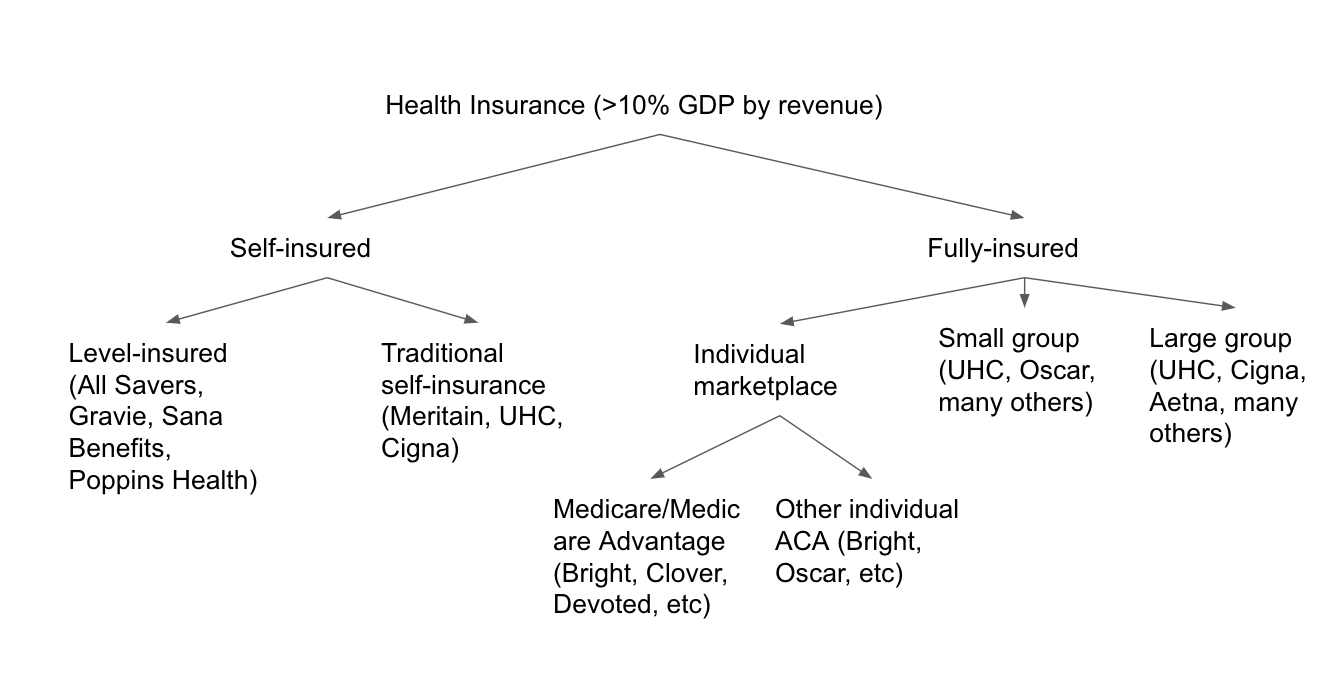
There are two categories of insurance, fully-insured and self-insured. These categories relate to health insurance, but also other types of insurance companies might buy for employees (including workers' comp, vision, dental, etc)
1. Fully-insured Policies
Insurance company collects fixed premium from every insured individual
Insurance company takes ownership over all claims, subject to cost-sharing
Can be bought on individual exchanges (B2C) or as company (B2B)
Regulated by federal laws like ACA and state laws (e.g. "community rating" rules)
2. Self-insurance
Strictly B2B, historically only available to large businesses
Legally, company issuing benefits is fully responsible for insurance claims
Company can buy insurance to cover its insurance obligations to limit downside
This insurance is called "stop-loss insurance". It is essentially reinsurance.
Only regulated by federal laws
Only need to satisfy MES (Minimum essential coverage) ACA laws
Must satisfy ERISA rules too, but these are less restrictive on plan design
3. Level-funded insurance
Is self-funded insurance combined with a financial product
Best of self-funding's "low-regulation" plus fully-insured's "high-predictability"
Solves for problem of companies wanting monthly payments (like fully insured)
self-funded stop-loss policies being over a full year
Just self-insurance with a financial product that makes yearly payments feel monthly
Better for small businesses who
can't take variability on balance sheet
are comparing product to fully-insured options
Fun fact: almost all large employers self-insure. Because of this, 64% of Americans with employer-sponsored insurance (non-Medicare, non individual-marketplace) are on a self-funded plan. src
Mezzanine: Why go self-insured?
There are four reasons to go self-insured:
In fully-insured plans, one of the things you pay for is renting capital
Renting insurance capital is expensive, more than similar bonds would cost
...so expensive there are whole companies devoted to lowering capital costs
e.g. Aegle Health Partners, Ledger Investing
For big companies with large balance sheets, saving on capital rent is huge
There are many fewer regulations that pertain to self-insured plans
ERISA pre-emption means that states cannot add rules to self-insured plans
In other markets, every state has their own rules
Can underwrite health benefits to the company's specific risk pool
healthier companies can get cheaper rates, which they can't do usually
in most insurance plans, rates are fixed in advance and same for everyone
in self-insurance, groups can get a custom price
the mechanics of how this works are sketchy (will write follow-up here)
MOST EXCITING FOR STARTUPS! Benefit plans can be customized and dynamic
There has been huge innovation in consumer health-tech products
e.g. One Medical, Forward, Tia, Wearable devices, etc.
biggest problem = new benefits not generally covered by insurance
legally can be covered, but more complicated and insurance co's are slow
current solution = redundancy
~60% of technology companies add ancillary benefits (e.g. Ginger, ClassPass)
this spend could be native part of health plan
growing pains solved
can customize plans (e.g. add support for new geography) easily
previously would have had to switch providers
Most exciting as a software engineer
self-insured plans own their claims data, and can smartly adapt spending
companies that sponsor fully-insured plans have no ability to see trends
claim data = insurance co property
in self-insurance, the insurance company is legally just the employer
Mid-floor: Downsides?
Complexity
Many questions must be answered, and any one wrong choice = landmine
network -- which one to rent (based on geography, employee needs)
ancillary -- buy any other services based on employee health needs?
stop-loss provider and contract terms
Require experienced HR leader willing to take risks. Not common.
Possibility of higher costs
Although self-insurance saves money on average, it has more variance
for some groups there is literally no risk though, depends on stop-loss
More work
In self-insured plans, the company must adjudicate claims and do compliance
Technically, the company can just hire a TPA to do this work, but that's work too
Top-floor: Additional resources?
1st vid of youtube series that is very helpful on stop-loss market
two podcasts I binge to for news about self-funded space